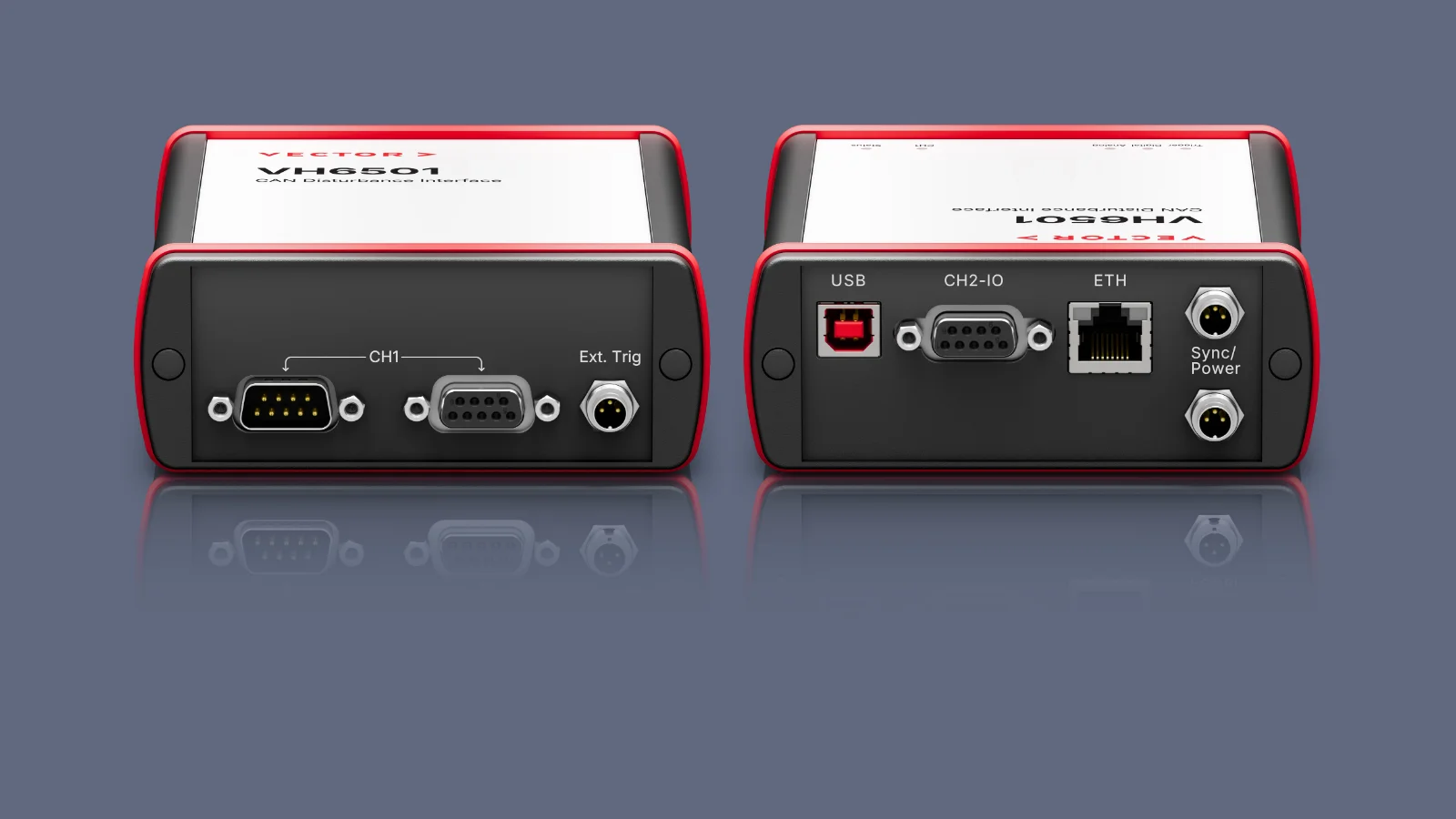
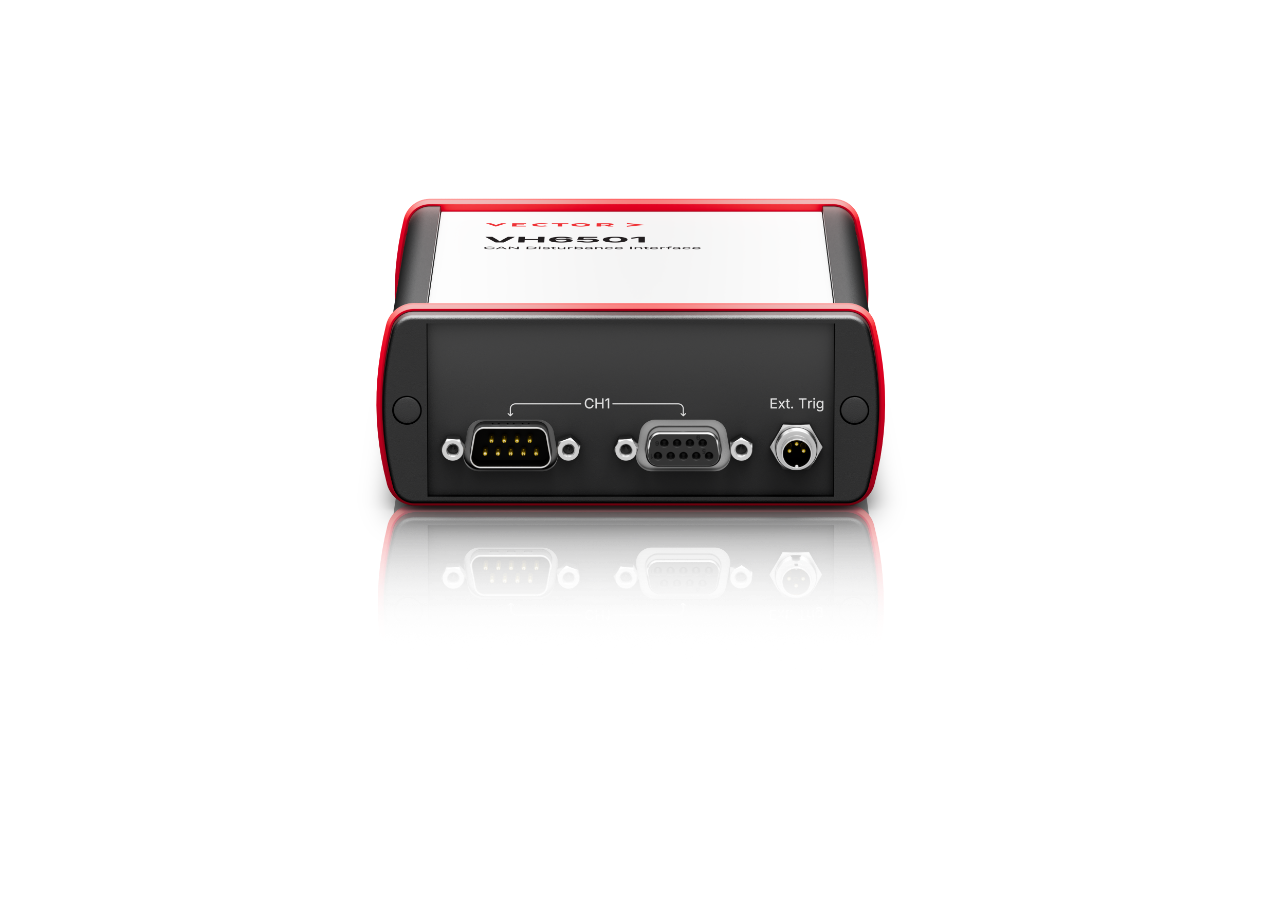
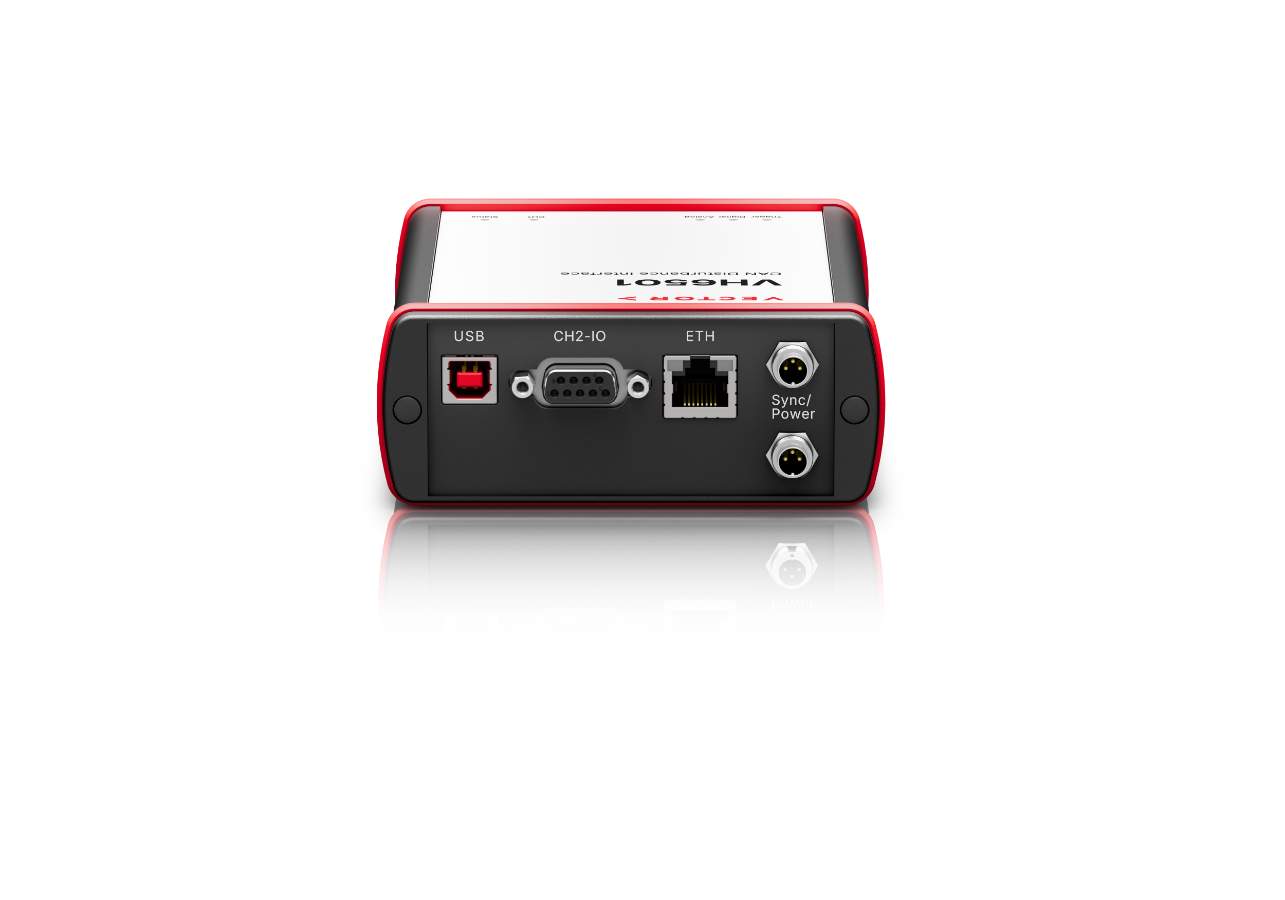
The VH6501 combines flexible CAN / CAN FD disturbance hardware and a network interface for CANoe in one compact device. This lets you set up CAN / CAN FD conformance tests easily, without an additional network interface or special cable.
Fully integrated into CANoe and automated via CAPL, it forms the basis for OEM conformance tests – from sample point checks to bus-off tests.
Highlights
- Two functions, one device: Disturbance hardware and network interface come together in one compact USB device.
- Trigger sources and disturbance types: Choose from an extensive range of trigger sources and disturbance types.
- Fine-grained output: Output even complex disturbances with fine granularity.
- External trigger output: A dedicated connector triggers other devices, such as an oscilloscope.
- Seamless CANoe integration: VH6501 fits right into your CANoe environment.
- Test automation with CAPL: Automate your tests with CAPL functions.
- Analog and digital I/O: 1 digital output, 2 digital inputs and 1 analog input are right on board.
- Time synchronization: Synchronize VH6501 with other Vector network interfaces by software or by hardware via SYNCcableXL.
Main Application Areas
VH6501 generates a wide variety of digital and analog disturbances in CAN / CAN FD networks, precisely and reproducibly. You need these disturbances for tasks such as:
- Determining the sample point
- Checking the behavior when receiving unusual or faulty CAN messages
- Checking the behavior on disturbances during transmission
- Deliberately forcing the bus-off state
OEM Conformance Tests
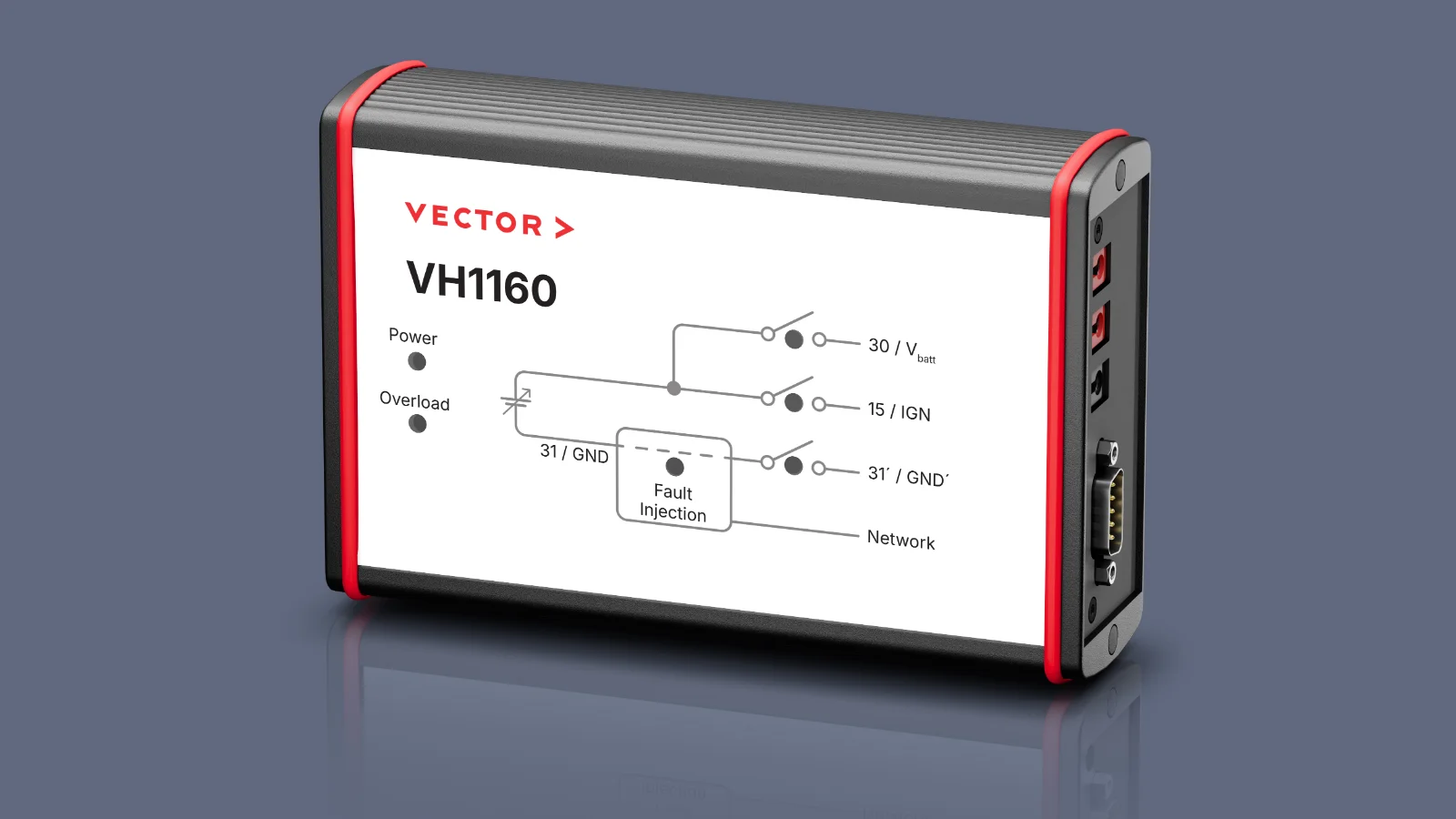
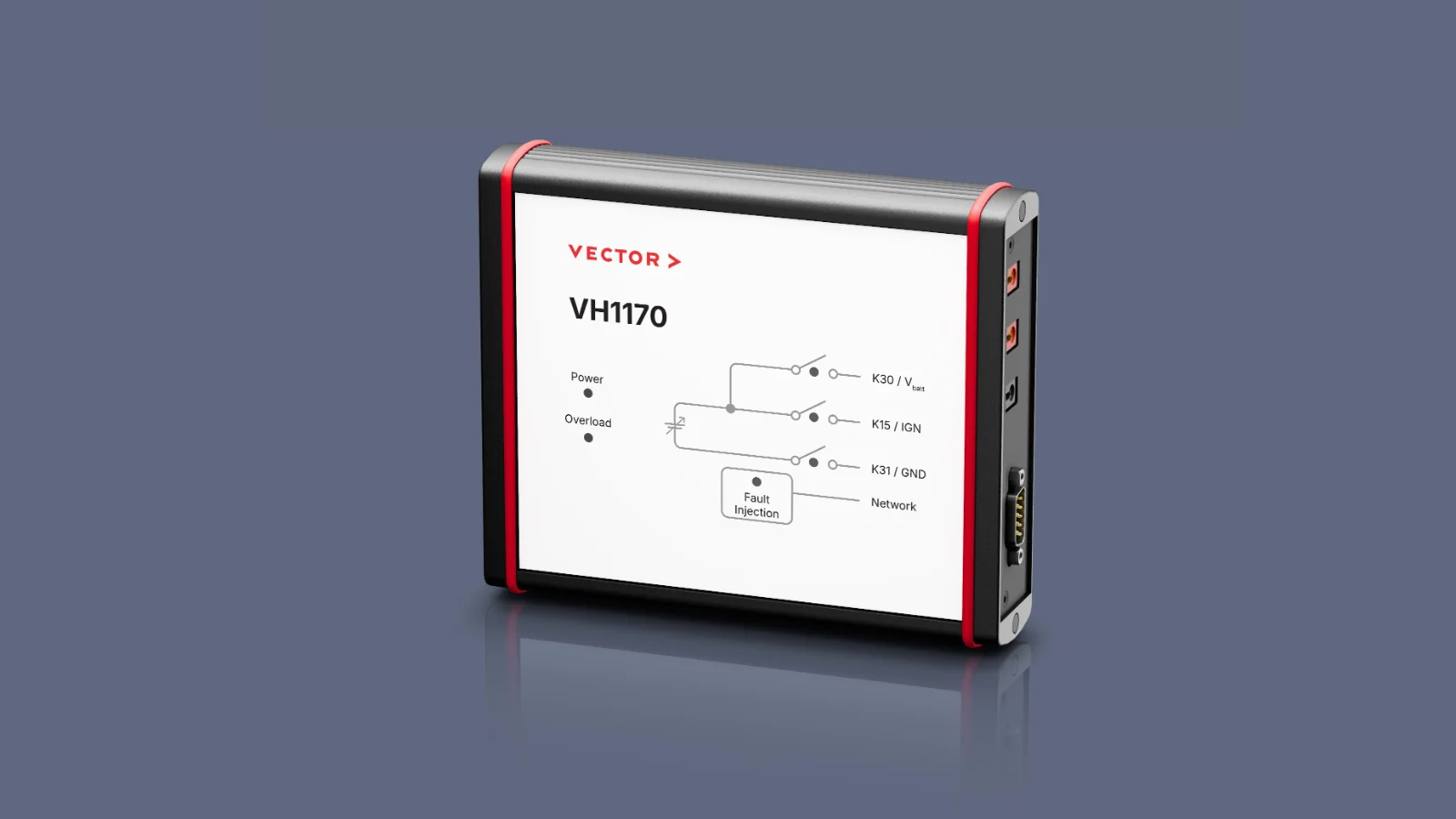
Tests like these are an essential part of the indispensable OEM conformance tests in the automotive industry. Thanks to the seamless integration into CANoe and the CAPL API, you implement them efficiently. One implementation example is the CANoe Test Package VAG. For complete test automation, it uses the VH1160 hardware for terminal control in addition to VH6501.
Precise Analysis of Disturbances
Optionally, the software CANoe.Scope and the required hardware visualize exactly the disturbances generated by VH6501 and the reactions in the CAN / CAN FD network. This lets you analyze events very accurately and create your own tests in a targeted way.
Functions
Digital Disturbances
- Arbitrary sequences of dominant and recessive levels (including recessive stress)
- Max. 4,096 level changes in a sequence
- Support for different trigger conditions:
- I/O triggers
- Frame triggers, e.g. SOF, Frame, Bus Idle, Error
- Combined frame triggers for disturbing e.g. different IDs (up to 32 parallel conditions including wildcards)
Analog Disturbances
- Asynchronous, without its own trigger condition
- Support for different error and test modes:
- Short-circuit tests
- Cross-wiring
- Modification of the R and C network parameters:
- R: 500 Ω...23,655 Ω (non-linear)
- C: 100 pF...10 nF (non-linear)
Gallery
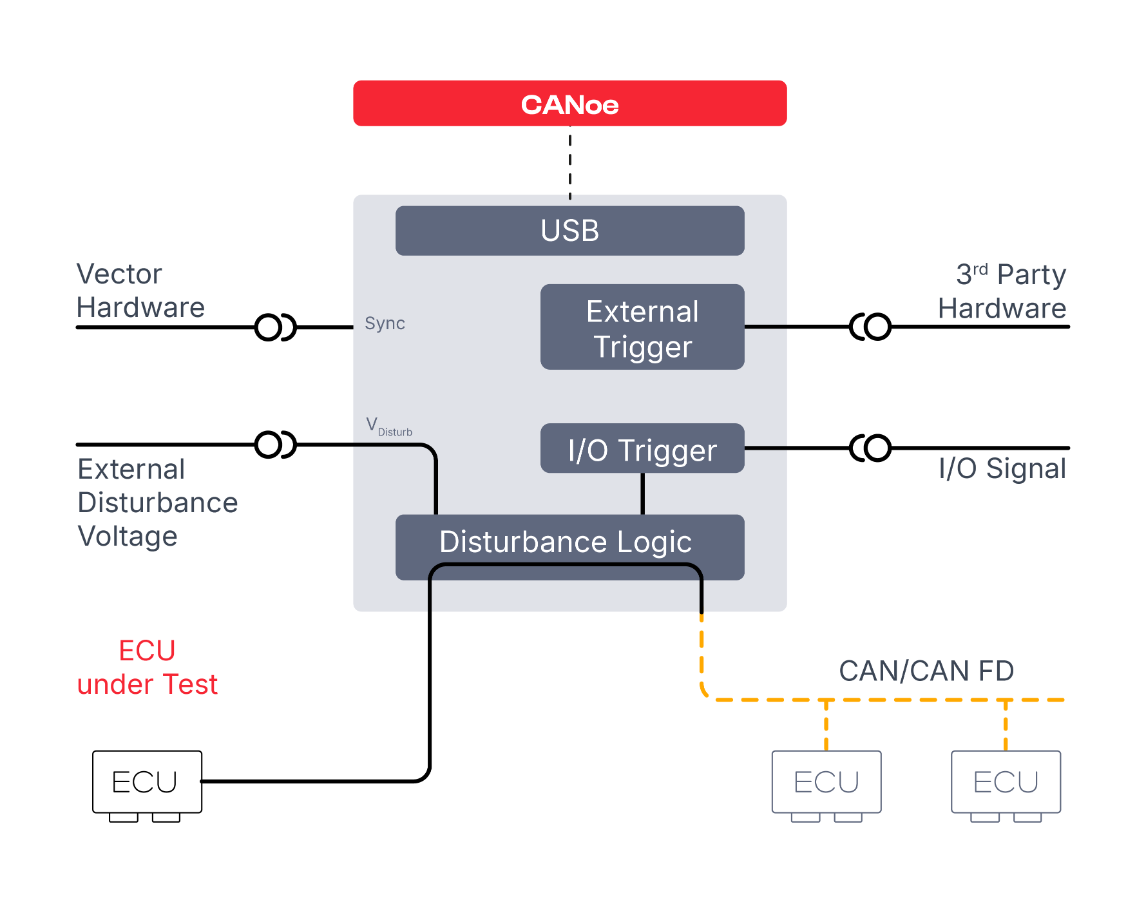
Setup Overview
Technical Data
| VH6501 | |
| CAN / CAN FD Channel |
|
| Digital CAN Disturbances | Arbitrary sequence of dominant and recessive levels:
|
| Analog CAN Disturbances |
|
| I/O Functionality (Onboard) |
|
| Analog Input |
|
| Digital Input |
|
| Digital Output |
|
| Connectors |
|
| Timestamps |
|
| PC Interface | USB 2.0 |
| Power Supply | 6 V ... <60 V DC Power-up: 9 V DC |
| Power Consumption | Typical 7 W |
| Operating System | Windows 10 (64 bit) / Windows 11 (64 bit) |
| Software Requirements | CANoe version 10.0 SP2 (SP3 or higher recommended) |
| Temperature Range | Operation: -40 °C ... +60 °C Storage: -40 °C ... +85 °C |
| Dimensions (LxWxH) | Approx. 155 mm x 111 mm x 45 mm |
| Weight | Approx. 600 g |


Related Products