Since 1996, CANoe has grown from a CAN bus test tool into an open platform for developing, simulating and testing complex systems – in automotive, aerospace, medical technology and beyond.
On this page, our management explains why validation has to start earlier in SDV development, and we show where CANoe is heading with AI and MCP. Our experts share Quick Tips for your everyday work, and throughout 2026, every new CANoe license comes with a free training voucher.
Thank you to all users and partners worldwide for 30 years of trust!

CANoe, Shift Left, and the Evolving Role of Validation in SDV Development

Management Interview
AUTOMOTIVE INDUSTRY
The evolution of CANoe over three decades reflects a broader shift in the automotive industry toward SDV development. How are Shift Left, AI, and virtualization redefining vehicle development?
In this interview, Dr. Matthias Traub and Jan Linnebacher explain why validation must start earlier and how speed, quality, and scalability can be mastered. It also highlights how CANoe is evolving from a validation tool into an open platform for the SDV era.
From Tool to Platform
Many Technologies. Every Challenge.
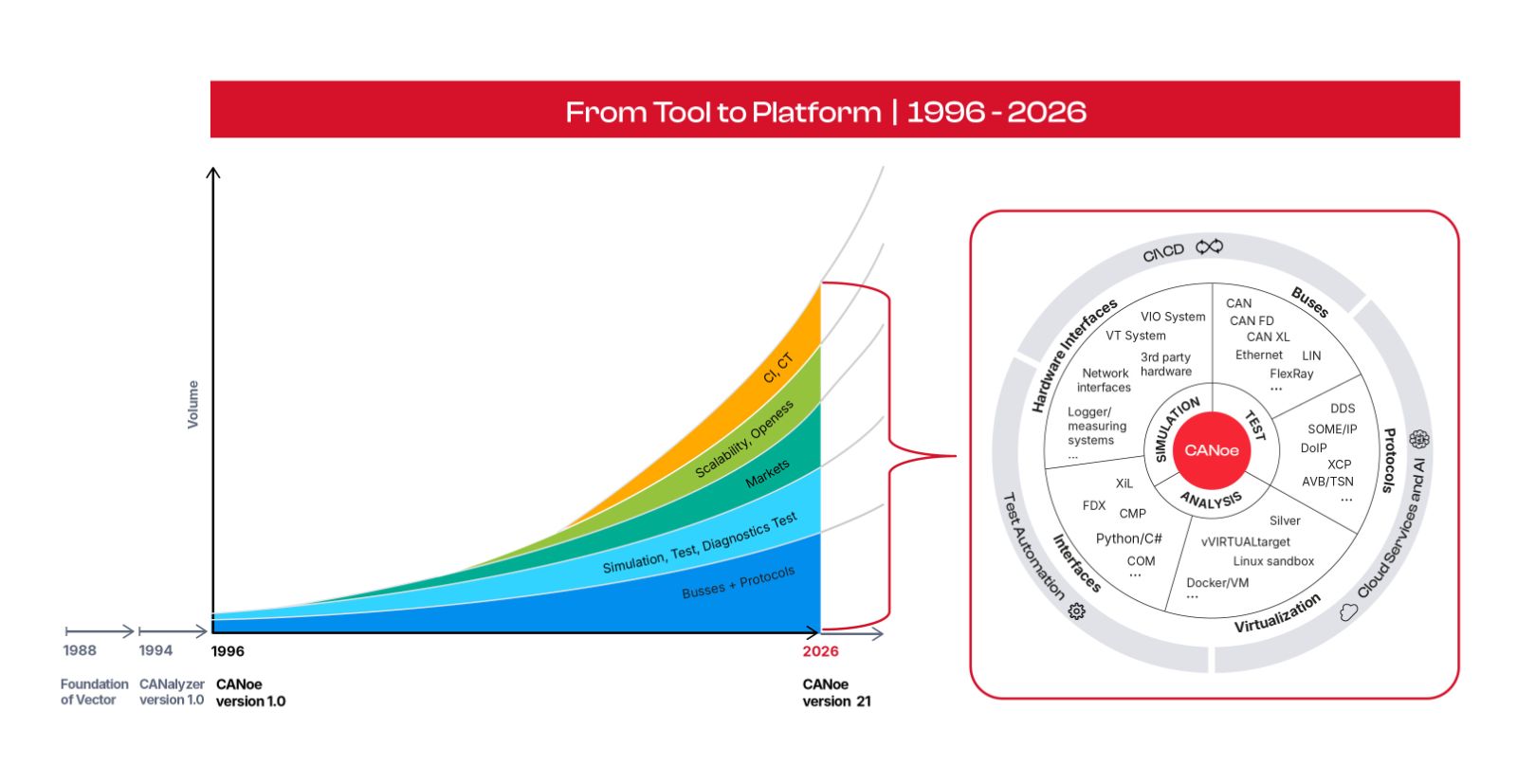
What began in 1996 as a supplement to the CANalyzer analysis tool marked the beginning of a highly successful product journey: From the initial specialized CAN bus development tool for automotive ECUs, CANoe evolved, version by version, into a central platform for the development, simulation, and testing of complex systems. Today, CANoe is an industry-independent test platform used worldwide. With open interfaces, versatile features and practical workflows, CANoe supports the integration of modern methods such as SIL/HIL testing and DevOps processes.

And We're Looking Ahead.
We continuously enhance CANoe to stay ahead of future challenges. Currently, we are expanding CANoe with AI and MCP features. These features will help you accelerate your engineering workflows and transform complex tasks into simple prompts. AI agents autonomously execute tasks in CANoe, identify relevant findings, and guide you through the next steps. This reduces manual effort, shortens development cycles, and enables both experienced CANoe users and newcomers to work more efficiently.


CANoe Quick Tips Directly From the Experts
Discover Hidden Gems
To celebrate CANoe's 30th anniversary, our experts are sharing helpful Quick Tips on practical features and workflows. They can streamline complex tasks or accelerate development. Explore useful capabilities you may not know yet, for example:
1. Core functions that are rarely used to their full potential.
2. Little-known features with significant impact.
3. Small, smart helpers that deliver surprisingly big results.
Why CANoe?
More Seamless Workflows.
Less Adjustment Effort.
Only CANoe provides a consistent, seamless toolchain from SIL to HIL – covering a wide range of automotive standards.
While other solutions rely on multiple tools or require extensive custom integrations, CANoe lets you reuse test cases and workflows with minimal effort. That saves time, reduces potential sources of error, and ensures a smooth, truly “out‑of‑the‑box” development process.
More Automation.
Less Manual Work.
With CANoe, you can build fully automated test sequences, simulations, and analyses – from test case definition all the way to final reporting.
Unlike competing solutions that depend on manual operation or limited automation, CANoe enables fully headless workflows, CI/CT integration, and server‑based test execution. This saves valuable time, minimizes errors, and increases overall test coverage.
More Integration.
Less Interface Hassle.
CANoe provides a unique platform that unifies vehicle and Ethernet domains, protocols, and diagnostics functions in a single solution.
Compared to other tools that require multiple standalone components, CANoe eliminates media breaks, simplifies system integration, and accelerates commissioning. For you, this means fewer interface challenges, fewer error sources, and faster project delivery.

More About CANoe