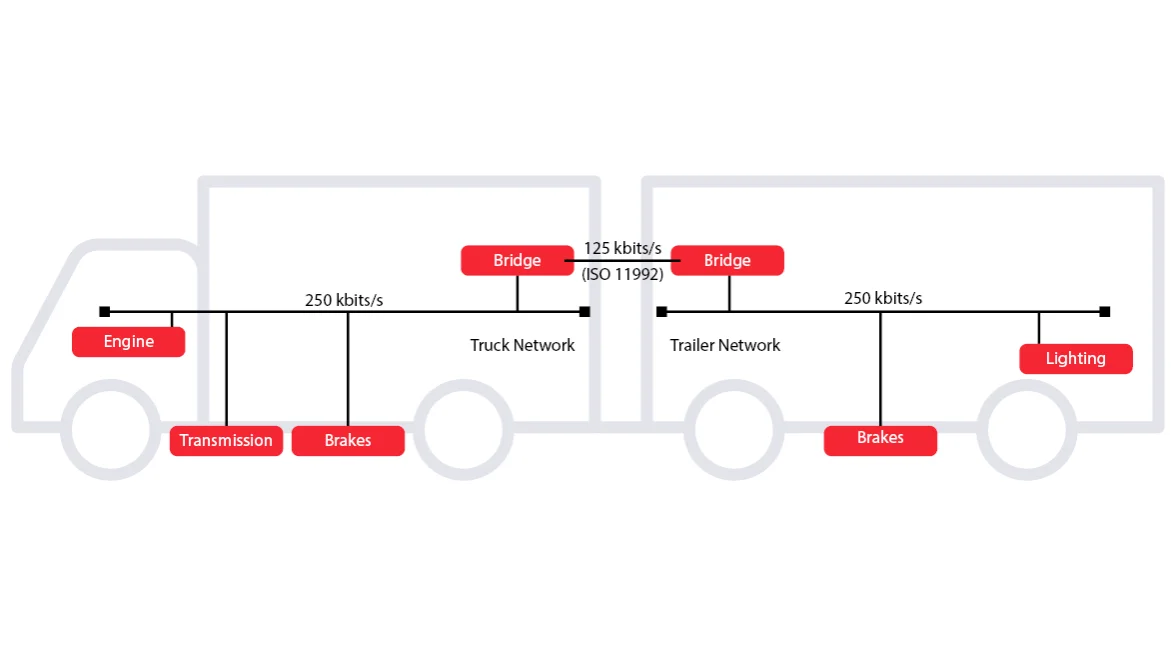
SAE J1939 is a CAN-based protocol family for communication between ECUs in commercial vehicles and mobile machines. It defines data transmission on the bus, parameter groups, signals, addressing, network management, transport protocols, and diagnostics. The standard also defines mechanisms for functional safety and security.
CANoe.J1939 extends CANoe with end-to-end, protocol-specific support for analyzing, simulating, and testing J1939 networks. Instead of dealing with protocol-handling details, users work directly with Parameter Groups, Suspect Parameters, and J1939 addresses. CANoe.J1939 automatically handles J1939-specific processes such as Address Claiming and the Transport Protocols.
Advantages
CANoe.J1939 extends the integrated CANoe environment with comprehensive, protocol-specific support for both classic and modern J1939 systems.
- Working with J1939 communication at the protocol level reduces manual effort.
Users work directly with parameter groups, Suspect Parameters, and J1939 addresses. CANoe.J1939 automatically maps them to bus communication in accordance with the protocol and handles Address Claiming, Request/Acknowledgment, and the J1939 transport protocols. This allows you to focus on the actual analysis, simulation, and testing tasks. - End-to-end support for J1939 and J1939-22 lets you work with classic and CAN FD-based networks in the same tool environment.
In addition to classic J1939 communication, CANoe.J1939 supports CAN FD-based J1939-22 with Multi-PGs, Contained Parameter Groups, and the FD Transport Protocol. - Integrated functional safety and security support enables you to investigate safety- and security-relevant communication.
CANoe.J1939 supports functional safety according to J1939-76, the relevant AUTOSAR E2E profiles and variants from the J1939 Digital Annex, as well as security-protected communication according to J1939-91C. This lets you generate and analyze protected communication and deliberately manipulate it for negative testing.
- Automated J1939 compliance tests reduce the effort required to verify protocol-compliant behavior.
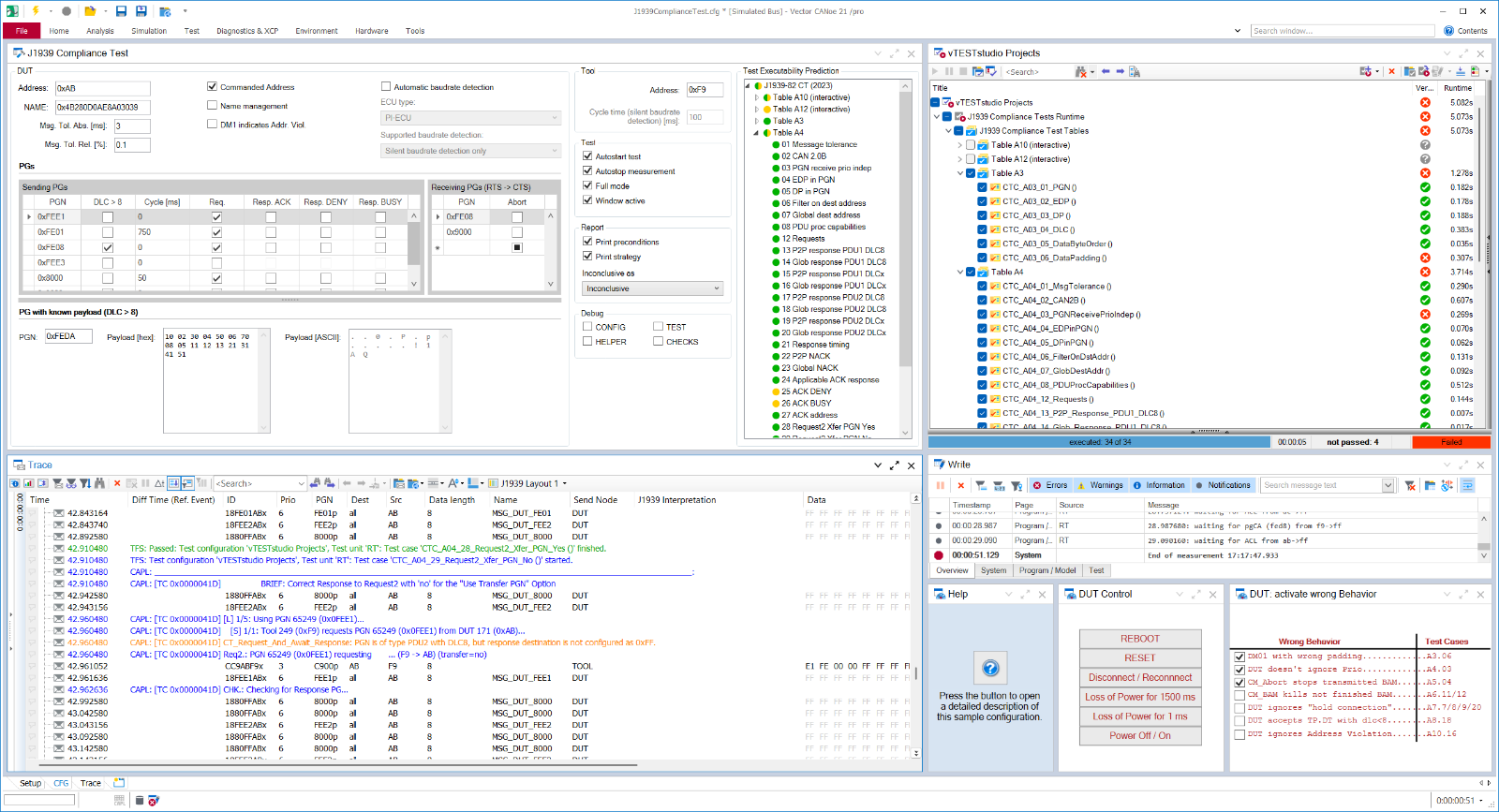
The preconfigured J1939-82 Compliance Test based on the 2023 revision automatically performs the standardized tests and documents the results in a test report. - The included J1939 database eliminates the effort of creating and maintaining standardized parameter groups.
The J1939.dbc created by Vector contains all standardized parameter groups from the Digital Annex and key J1939 documents. - Integrated diagnostic support makes it easier to analyze and isolate faults in the J1939 network.
J1939 defines its own diagnostic services. To support targeted analysis of these services, CANoe.J1939 provides dedicated windows for displaying and accessing Diagnostic Trouble Codes, OBD-relevant J1939 diagnostic information, and diagnostic memory.
Application Areas
- Develop and validate classic J1939 ECUs and networks early
Even in early development phases, before real hardware is available, you can test ECU interaction and investigate network behavior under different conditions. CANoe.J1939 simulates missing network nodes and their J1939 communication.
- Setup and integrate J1939-22 networks (CAN FD)
With support for Multi-PGs, C-PGs, and FD.TP, you can develop, analyze, and test CAN FD-based J1939-22 communication. You can also investigate and validate migration and gateway scenarios between classic J1939 and J1939-22-based networks.
- Implement and validate safety and security functions
CANoe.J1939 generates and analyzes safety- and security-protected communication and enables targeted frame manipulation to investigate fault scenarios. For functional safety, it supports J1939-76, relevant AUTOSAR E2E profiles, and the variants defined in the J1939 Digital Annex. For security use cases in J1939-22 networks, support for SAE J1939-91C is included.
- Verify and demonstrate J1939 compliance
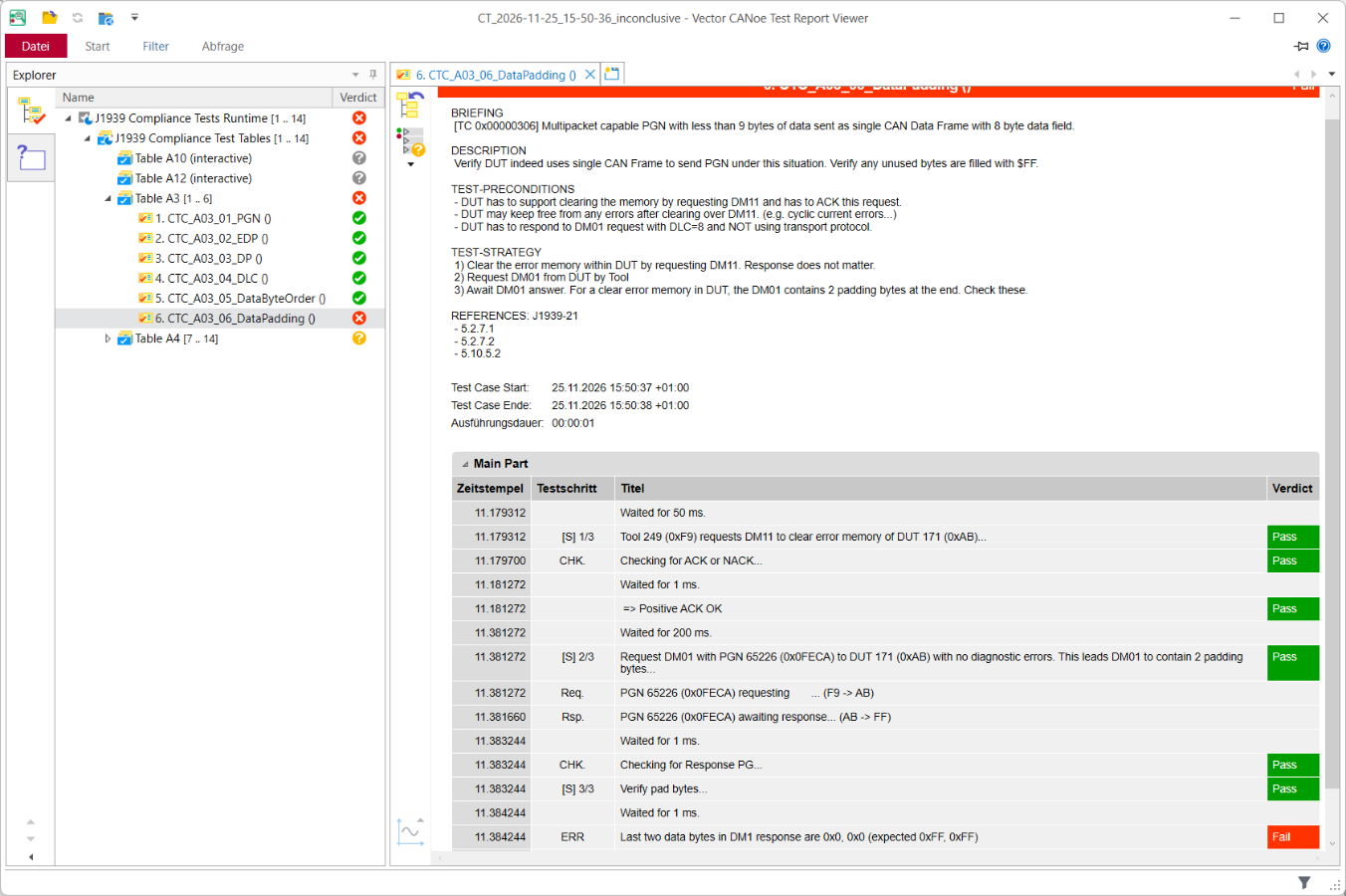
The preconfigured test environment lets you verify whether an ECU meets the requirements of SAE J1939-82, Revision 2023. You configure the Device under Test using an intuitive user interface. CANoe.J1939 then runs the tests and documents the results in a test report.
Gallery
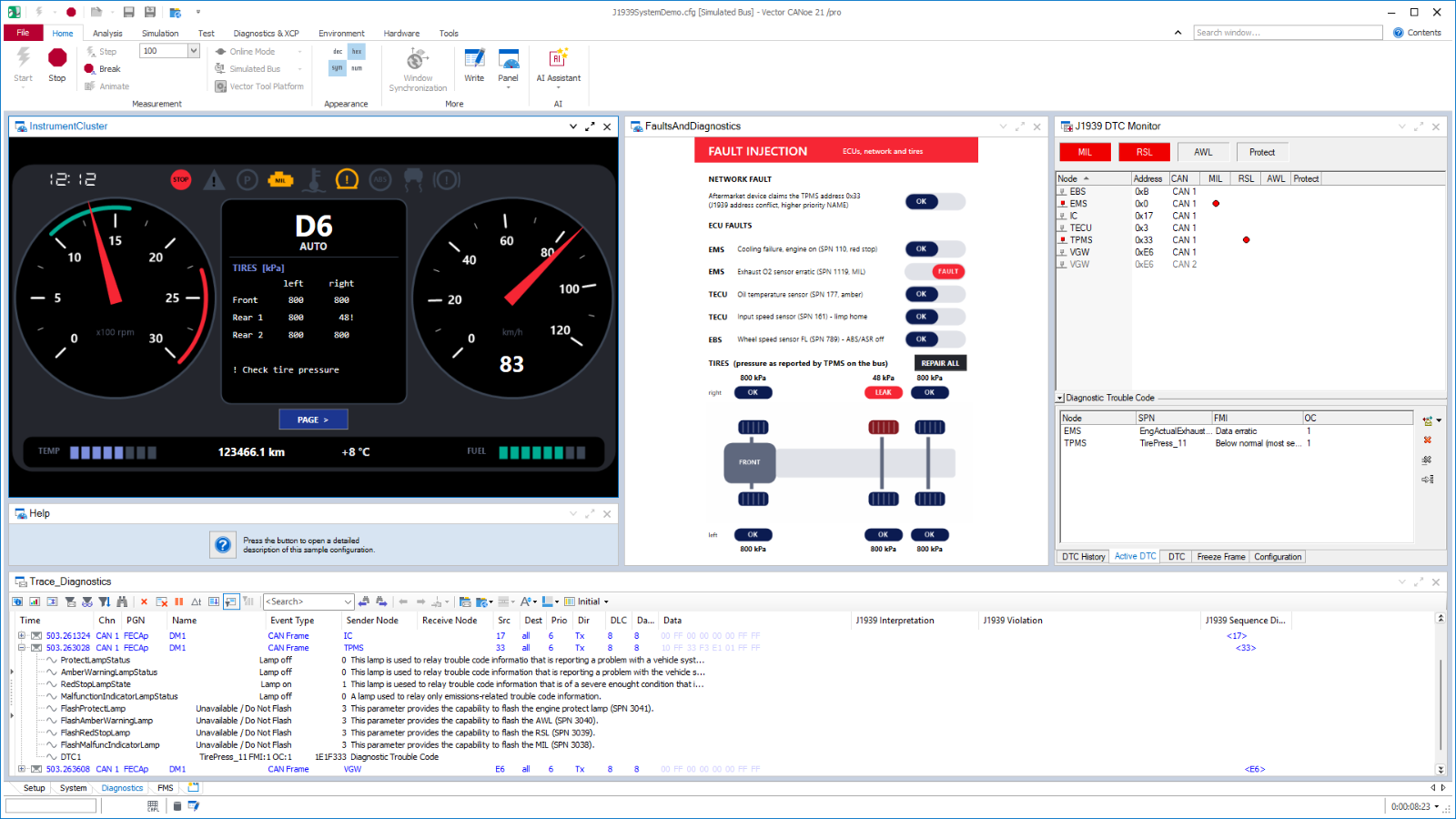
Simulation and Stimulation
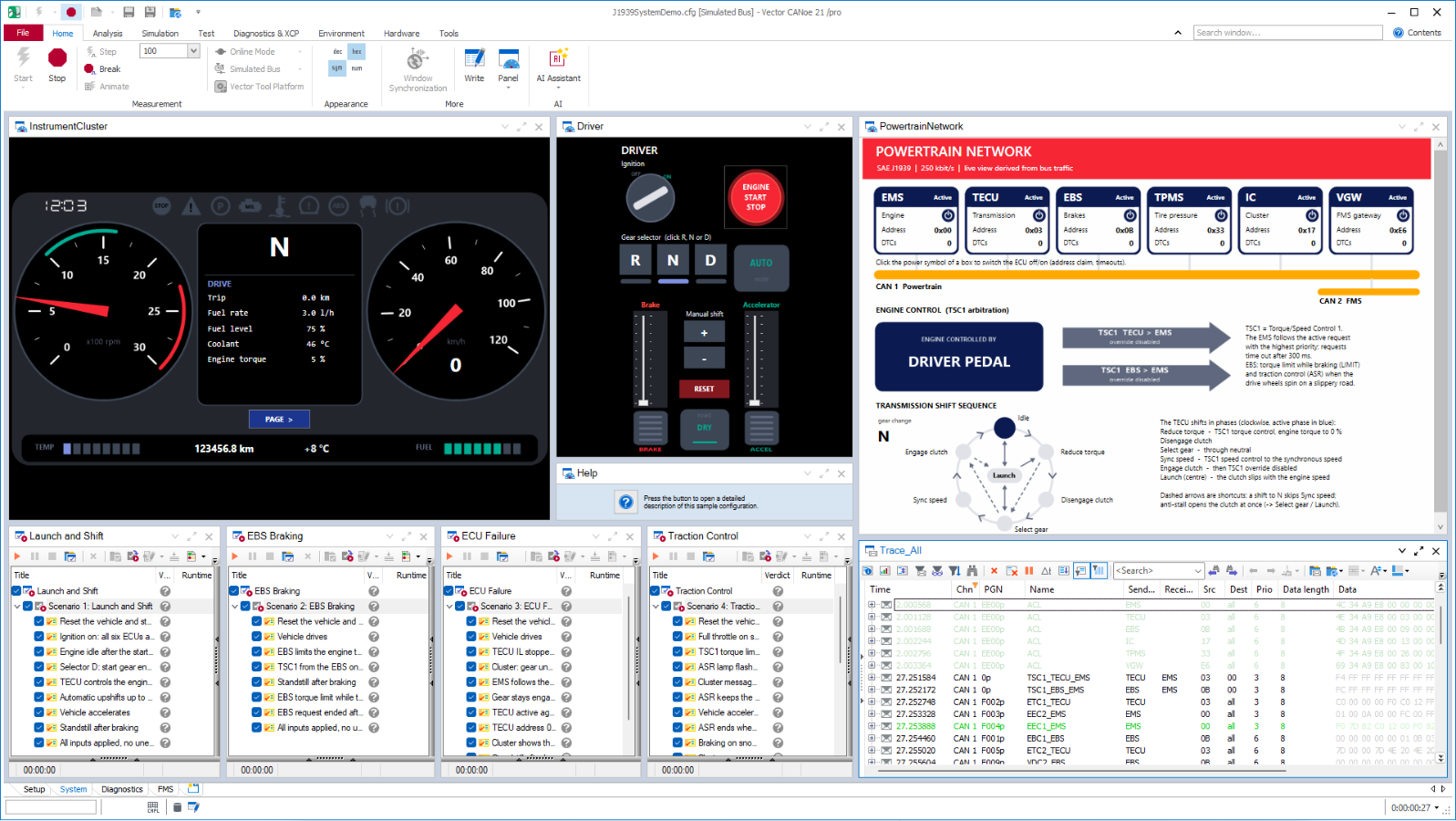
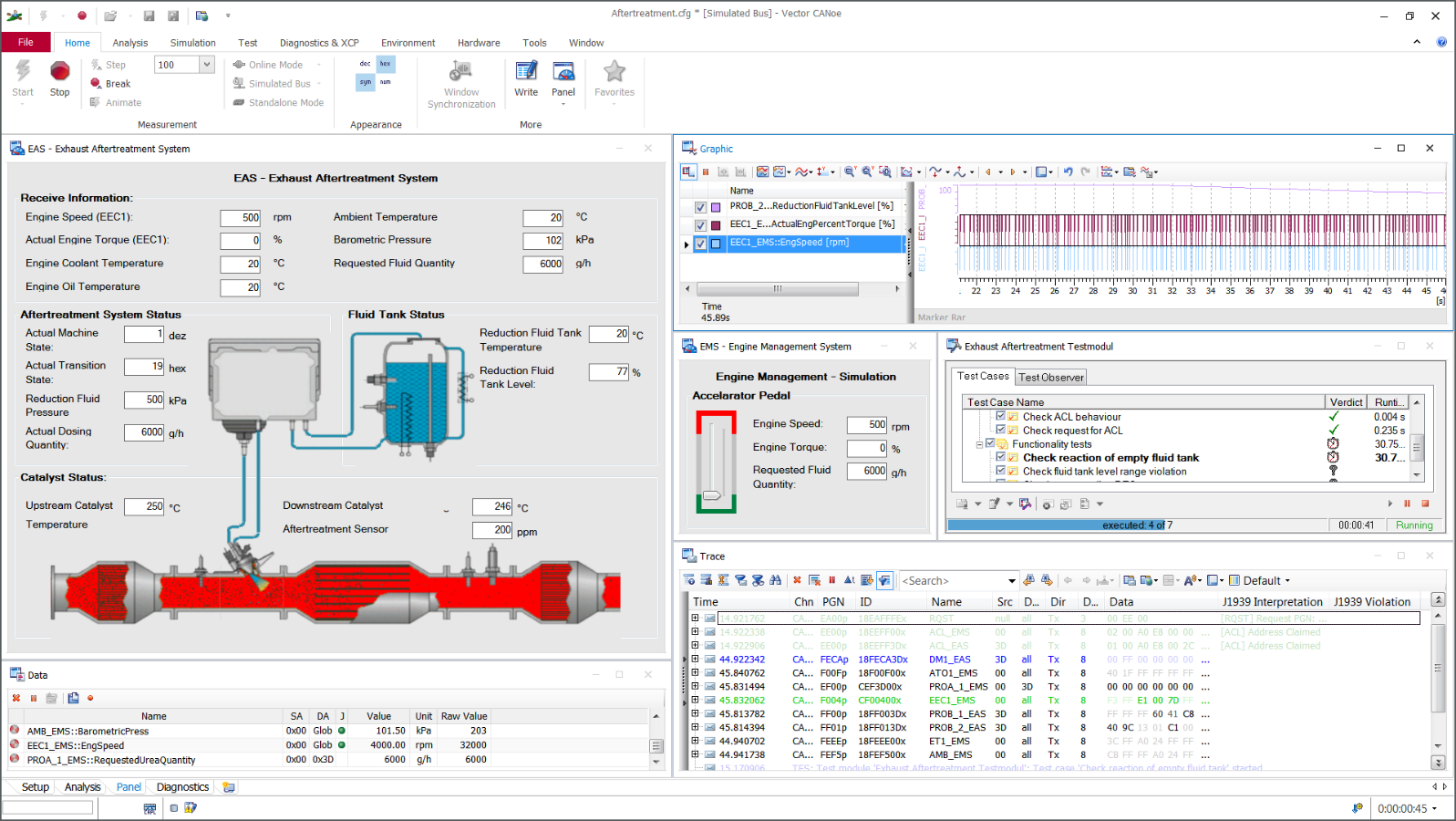
CANoe.J1939 makes it easy to simulate J1939 ECUs. The J1939 Interaction Layer provides the ECU's typical communication behavior out of the box. Configuration and control take place at the abstract level of J1939 Parameter Groups (messages) and Suspect Parameters (signals). CANoe.J1939 handles the exact implementation in bus communication.
- The Interaction Layer handles key J1939 communication mechanisms, including Address Claiming and Request/Response/Acknowledgment. It includes both the transport protocol according to J1939-21 and the CAN FD Transport Protocol according to J1939-22, supporting connectionless (BAM) and connection-oriented (RTS/CTS) transmission. It also processes Multi-PGs and Contained Parameter Groups (C-PGs) according to J1939-22.
- Functional safety and security mechanisms are processed automatically.
- The integrated CAPL programming language lets you extend or deliberately modify the standard behavior of a simulated ECU, for example through situation-dependent transmission, timing changes, or manipulation of the ECU state, checksum, counter, and data ID. You can also implement intentional protocol violations.
- Dedicated CAPL functions also make it easy to implement diagnostic protocols according to J1939-73.
Analysis
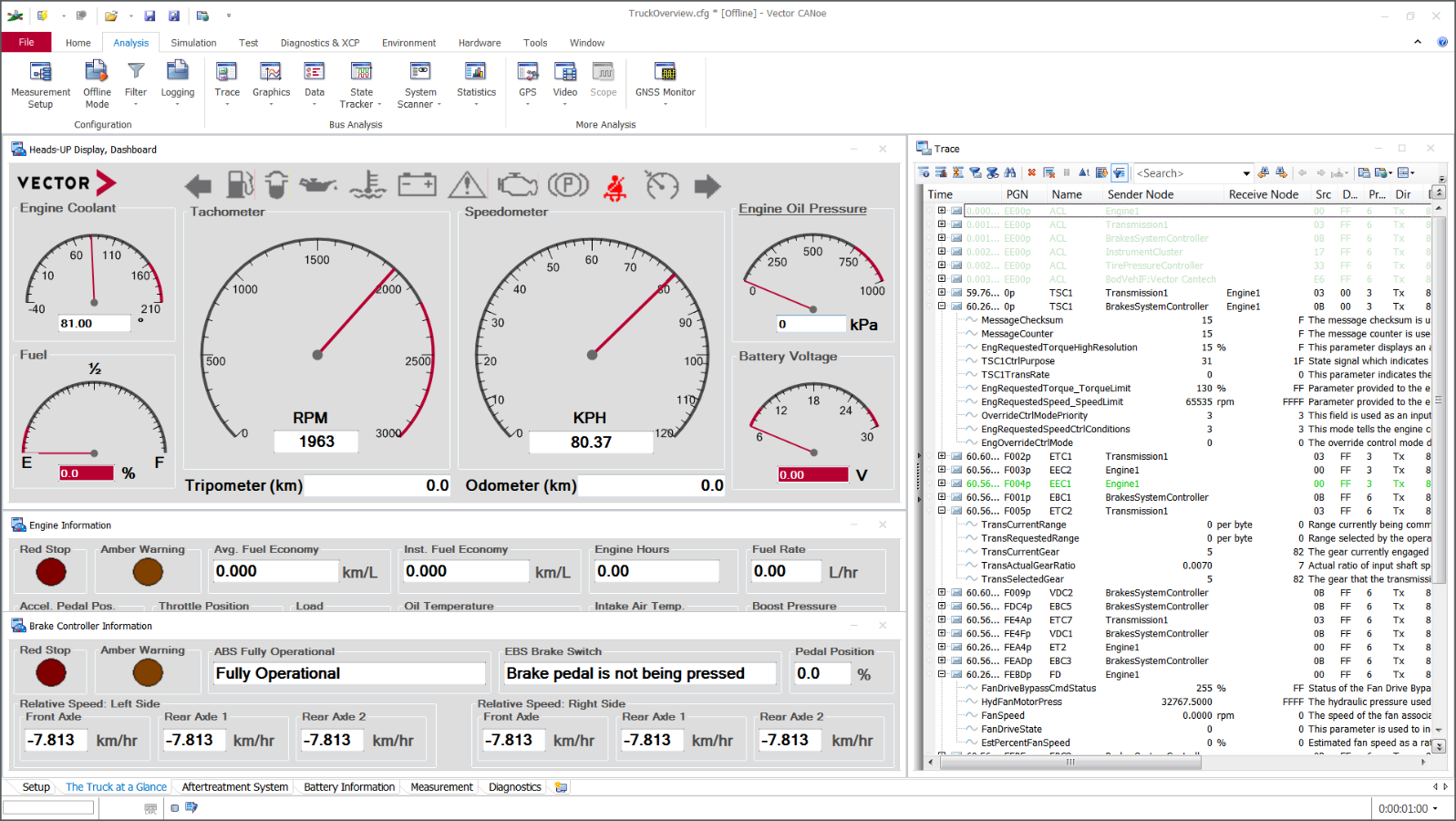
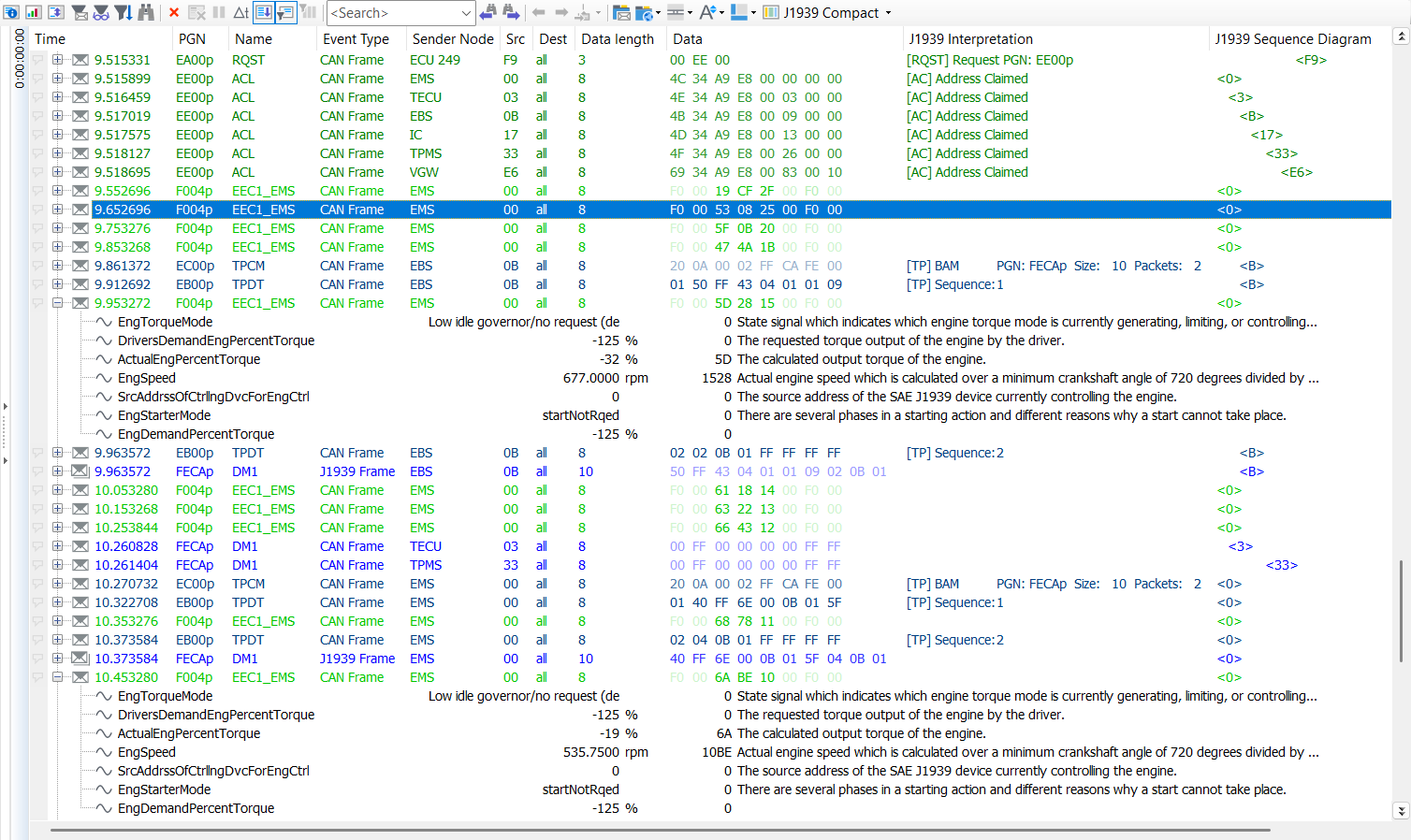
The Trace Window is the center of J1939 analysis and automatically displays bus communication at the protocol level. Additional dedicated diagnostic windows are available for specific diagnostic tasks.
J1939 Analysis in the Trace Window
- The Trace Window automatically combines the individual frames of the J1939 transport protocols into complete parameter groups.
- For J1939-22, it extracts the individual C-PGs from Multi-PGs and displays them separately.
- It breaks down the CAN identifier into J1939-relevant components such as PGN, Source Address, Destination Address, and Priority.
- Users can flexibly configure which protocol-specific information is displayed.
- Easy-to-use filters, including J1939-specific filters, limit the display to the relevant communication parts.
- CANoe.J1939 automatically detects nearly all J1939 protocol violations and alerts the user.
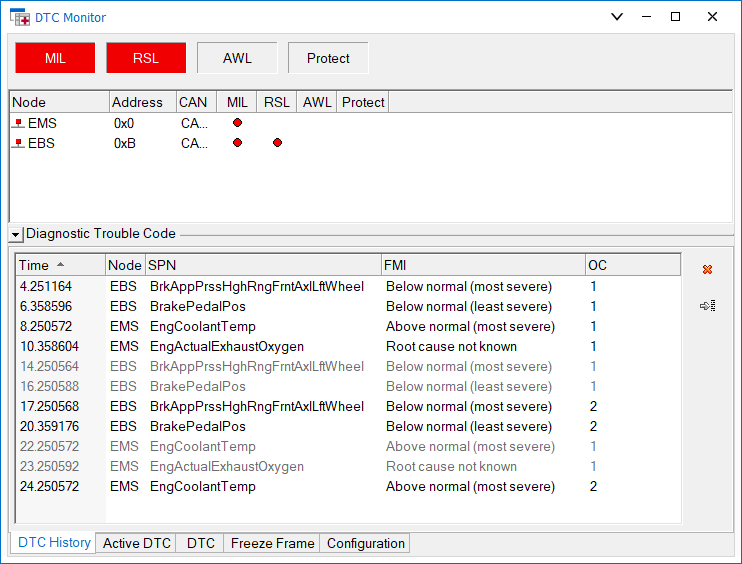
Dedicated Diagnostic Windows
Three dedicated windows complement the versatile Trace Window with displays and controls for specific diagnostic tasks.
- The DTC Monitor provides a clear display of Diagnostic Trouble Codes and supports targeted investigation.
- The OBD-I/M Monitor displays emissions- and OBD-relevant J1939 diagnostic information.
- The Diagnostic Memory Access window provides direct access to the diagnostic memory of a J1939 ECU.
Testing
CANoe.J1939 provides J1939-specific test functions that allow you to automatically test for protocol-compliant behavior, detect errors as they occur, and generate targeted fault scenarios.
Automated Testing of J1939 Communication
- General test functions check cycle times, data lengths, message intervals, node activity, and the occurrence of messages directly in J1939 communication.
- Specialized test functions cover virtually all key aspects of J1939 communication, including Address Claiming, BAM, Request/Request2, RTS/CTS, and functional safety according to J1939-76.
- The test functions also detect communication errors that occur during a test without being intentionally induced.
Testing Functional Safety and Security According to J1939-91C
- Safety-protected communication can be tested in a targeted manner. CANoe.J1939 can generate correct communication or deliberately manipulate counters and checksums to produce faulty communication.
- For J1939-91C, you can systematically investigate security-relevant fault scenarios. Tests can trigger Rekeying, manipulate the Freshness Value, CMAC, or E-Bit in the Security Header, delay responses, and overwrite the Network Key or current Session Key.
Executing the J1939-82 Compliance Test
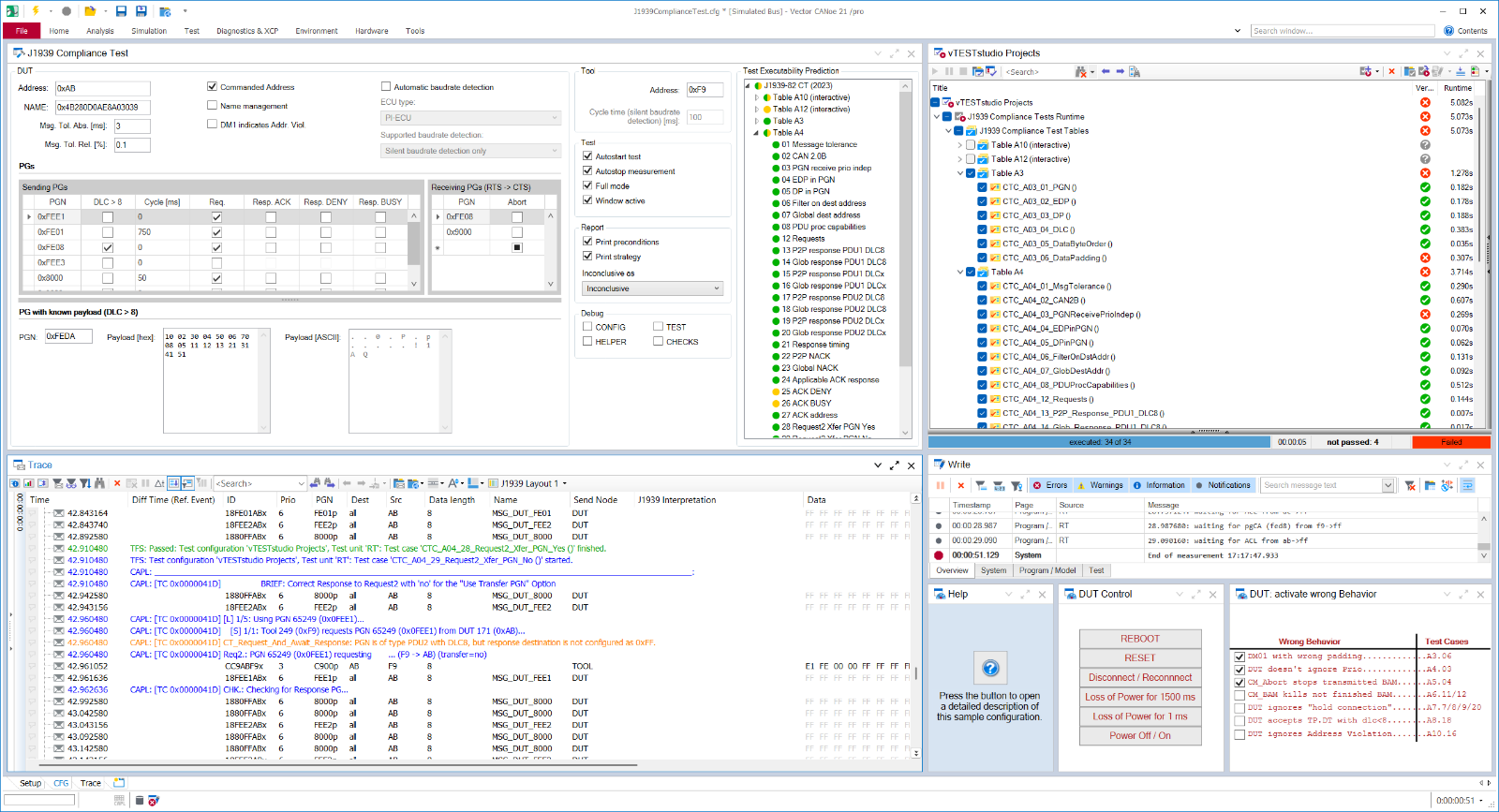
- After guided configuration of the Device under Test (DUT), CANoe.J1939 automatically runs the applicable tests according to SAE J1939-82, Revision 2023, evaluates the results, and summarizes them in a test report.
Database Support
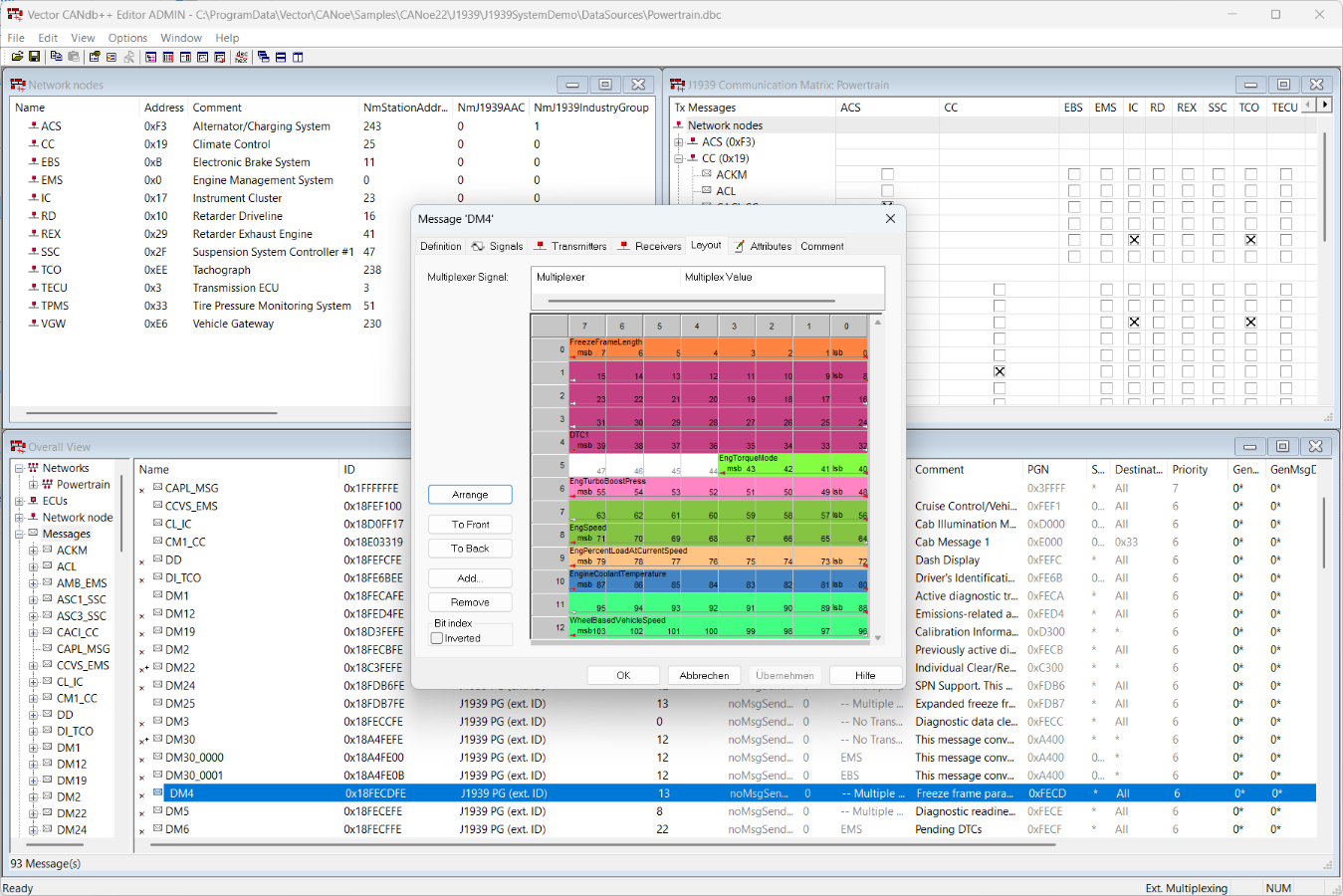
The CANoe.J1939 delivery includes a database specifically prepared for J1939. It contains all parameter groups from the current J1939 Digital Annex and the specifications SAE J1939-21, J1939-71, J1939-73, J1939-76, and J1939-81. This saves time because you no longer need to create these standardized definitions yourself.
You can extend this file with proprietary parameter groups or combine it with your existing DBC databases. Furthermore, AUTOSAR databases with J1939 clusters are also supported directly.

Training
CANoe.J1939 Seminars
CANoe.J1939 provides a variety of possibilities for simulating, developing and testing J1939 systems. But only those who are familiar with these options can fully tap the potential and save time and money. Take advantage of our training and education offers in order to make even more efficient use of CANoe.J1939 in your day-to-day work!