LIN Error Interpretation
CANoe Quick Tip

LIN is a UART-based protocol, meaning that each LIN frame is composed of multiple bytes transmitted by the UART module of a microcontroller. In most cases, the application of a LIN responder node runs on the same microcontroller as the LIN protocol stack, which is typically implemented in software. As a result, the application software and the protocol software share the same microcontroller resources. This can sometimes lead to timeout errors that are difficult to trace. The LIN error interpretation feature helps to diagnose and resolve these issues.
What Can You Do With This Function or Workflow? What Problems Does It Solve?
There are several error scenarios that can occur: the errors can be categorized into local and global errors.
The LIN error interpretation clarifies the following local errors:
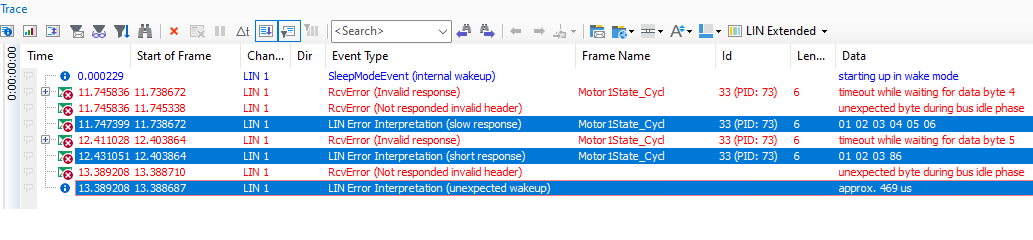
And the LIN error interpretation clarifies the following global errors and information:
- If a LIN Commander is being simulated and a real LIN Commander is simultaneously located on the connected network, collisions will occur. Such collisions are detected by a heuristic interpretation of the communication errors on the network.
- If the configured baudrate differs from the baudrate used on a connected real network, then a communication error on the connected network is interpreted. This situation is detected by a heuristic interpretation of the communication errors on the network.
- Detection of an invalid break delimiter. The valid break delimiter is to have a length of at least one bit time. The specification recommends a delimiter length of at least 2 bit times.
Where Can You Find This Function in CANoe? | How to Start the Process?
Local errors are clearly visualized in CANoe’s Trace Window, while global errors are conveniently reported in the Write Window – giving you full transparency and immediate feedback during analysis.
Related CANoe Topics