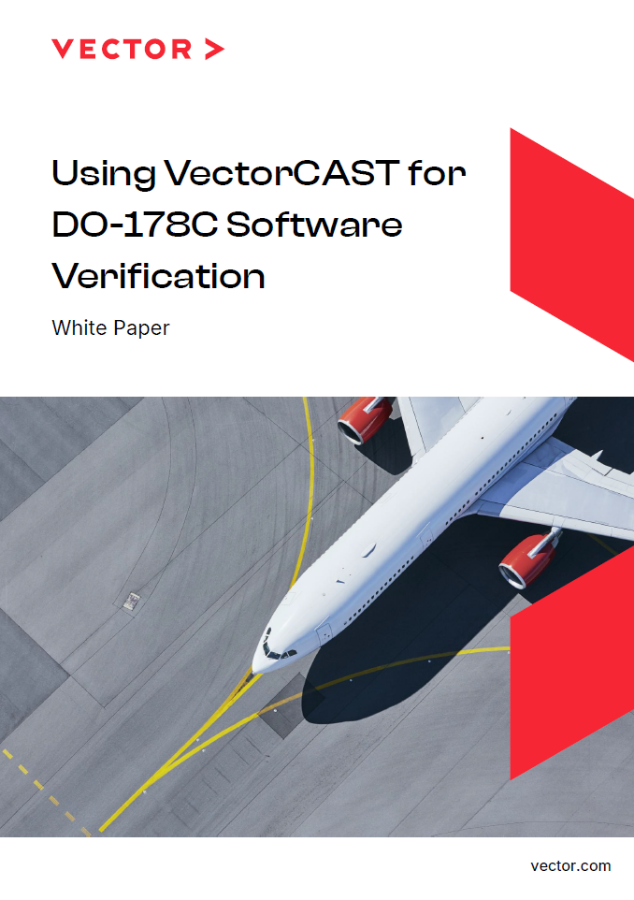
Verifying Aerospace Software with VectorCAST
Certifying airborne software under DO-178C and ED-12C requires both requirements-based testing and structural code coverage. The required coverage increases with the software level, reaching MC/DC at Level A. This whitepaper shows how VectorCAST produces that evidence and the artifacts a certification effort must present.
What the White Paper Covers
- Map each DO-178C and ED-12C verification objective to a VectorCAST capability
- Build normal-range and robustness test cases from requirements
- Demonstrate structural coverage to Level A, including MC/DC
- Verify data and control coupling across components
- Reuse coverage across test phases to cut duplicated low-level work
- Qualify VectorCAST for certification with the TQL matrix and qualification kit
Software Levels and Structural Coverage
DO-178C, published in Europe as EUROCAE ED-12C, sets the guidelines that avionics organizations and certification authorities such as the FAA, EASA, and Transport Canada use to approve airborne software. A system safety assessment sets the software level, and each level carries its own structural coverage objective. Levels A through C are shown below; Levels D and E carry no structural coverage objective, covering minor failure conditions and software with no effect on the aircraft or crew.
Level A
Catastrophic failure condition
Structural Coverage
Statement, Decision, and MC/DC
Level B
Hazardous failure condition
Structural Coverage
Statement and Decision
Level C
Major failure condition
Structural Coverage
Statement
Where VectorCAST Fits
VectorCAST/C++ and VectorCAST/Ada automate unit and integration testing of C, C++, and Ada source code, automatically generating and compiling the test stubs and driver programs. VectorCAST/QA collects coverage during functional or system testing. The Requirements Gateway links requirements to test cases, and the Runtime Support Package extends execution to embedded targets and simulators. VectorCAST/Timing adds worst-case execution time analysis, computing timing from measured execution data to produce the statistical evidence a safety case relies on.
Tests are independent of the source code, so the same test cases run on the host, on a simulator, or on the target. When an application moves to a new processor or compiler, the regression mechanism rebuilds the test harnesses and re-executes the existing tests in the new environment.
VectorCAST Tool Qualification
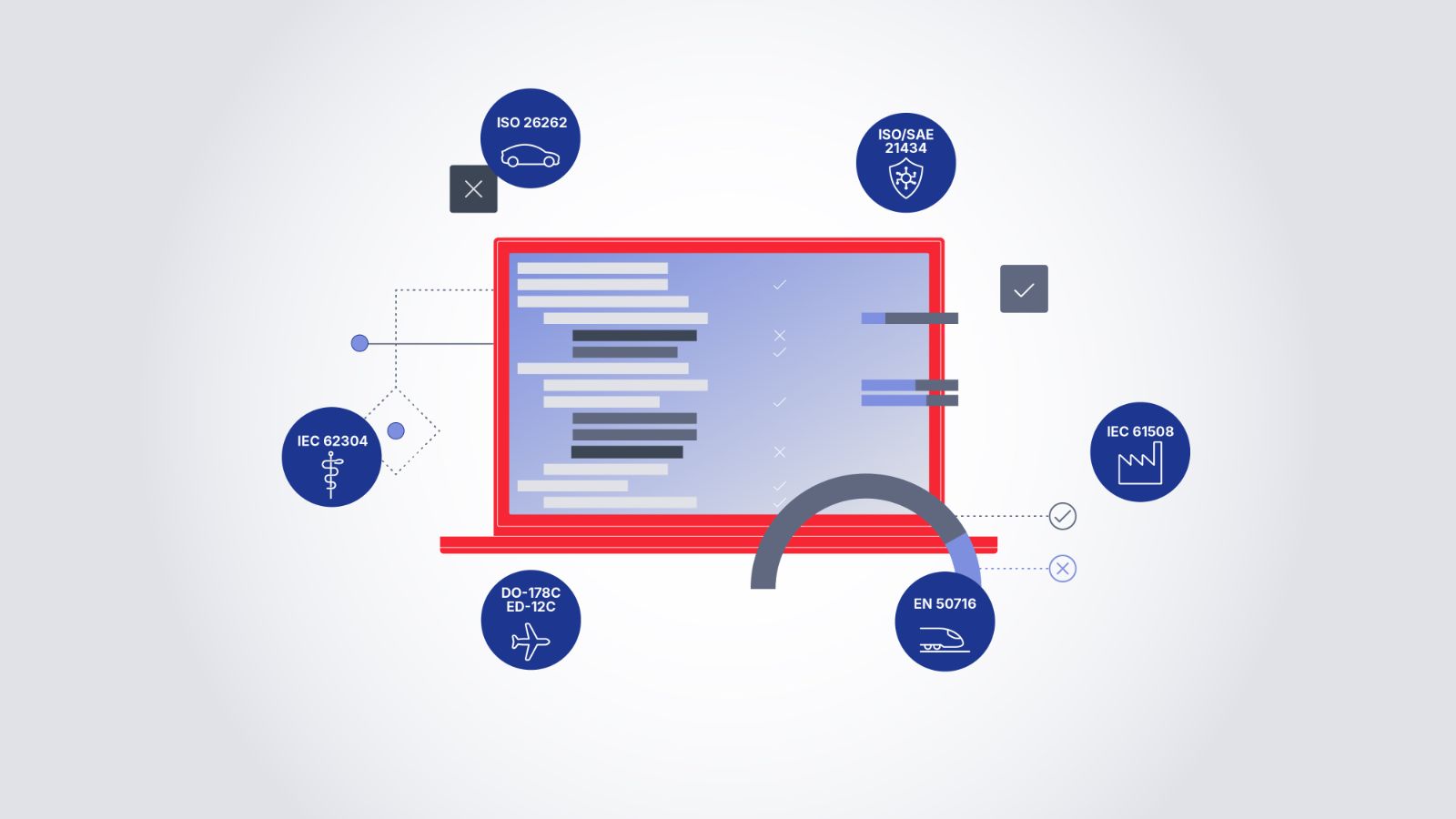
DO-178C and ED-12C require tool qualification when a tool automates or reduces a verification process and its output is not independently verified. VectorCAST performs low-level requirements validation and coverage reporting, so it must be qualified. Vector provides an off-the-shelf qualification package tailored to each project. The whitepaper outlines the Criteria Levels, the Tool Qualification Level matrix, and the qualification kit contents.
Get the White Paper
Get the full account, with coverage reports, the qualification matrix, and worked examples in one document.
Using VectorCAST for DO-178C Software Verification
VectorCAST White Paper
Version 4.0 | October 2026