Case Study Tata Elxsi: ECU Virtualization for Automated SIL Testing
Reduce ECU Testing Time From 10 Days to Less Than 8 Hours With Automated SIL Testing
The Customer
Tata Elxsi is among the world’s leading providers of design and technology services across industries including automotive, broadcast, communications, healthcare, and transportation. Tata Elxsi works with leading OEMs and suppliers in the automotive and transportation industries for R&D, design, GenAI and product engineering services from architecture to launch and beyond. It brings together domain experience across autonomous, electric, connected vehicle technologies and software-defined vehicles (SDVs), supported by a worldwide network of design studios, development centres, and a global talent pool of over 11,000 engineers and specialists.

The Challenge
Enable testing in a Software-in-the-Loop (SIL) environment by virtualizing an AUTOSAR ECU, simulating external components and transforming manual test procedures into executable, automated test cases.
Traditional Hardware-in-the-Loop (HIL) testing requires physical test benches and manual effort. Software-in-the-Loop (SIL) testing reduces this dependency by executing ECU software in a virtual environment, removing the need for hardware and allowing for scalable testing.
A key requirement is that the virtual ECU (vECU) runs the same software as the production ECU. If the software differs, tests will need to be repeated on hardware, reducing the value of virtualization. Maintaining identical behavior and interfaces is essential.
In this target use case, the ECU processes input signals from physical input controls for various application functions. The ECU communicates with peripheral devices over serial interfaces such as I²C, while data exchange with other vehicle ECUs takes place via the CAN network.
Another challenge involves sleep and wake scenarios. The ECU may be in sleep mode or powered off. When a network management frame arrives via CAN or a GPIO signal is received from a peripheral device, the ECU must wake up or power on. The application must identify the wake-up source and perform the correct actions, such as a specific boot sequence and system status check. These behaviors must be modeled and validated in the virtual setup.
Signals from connected peripherals and serial interfaces also need to be simulated for full interaction with the vECU. Manual test steps must be converted into automated test cases to support continuous integration and regression testing.
The goal is early software testing without hardware, reducing manual effort, while integrating automated tests into a CI/CT pipeline. This approach supports faster development cycles and consistent test coverage.
The Solution
Create a Level 3 vECU using virtual MCAL drivers and CANoe based bus simulation to enable comprehensive testing at a software qualification level.
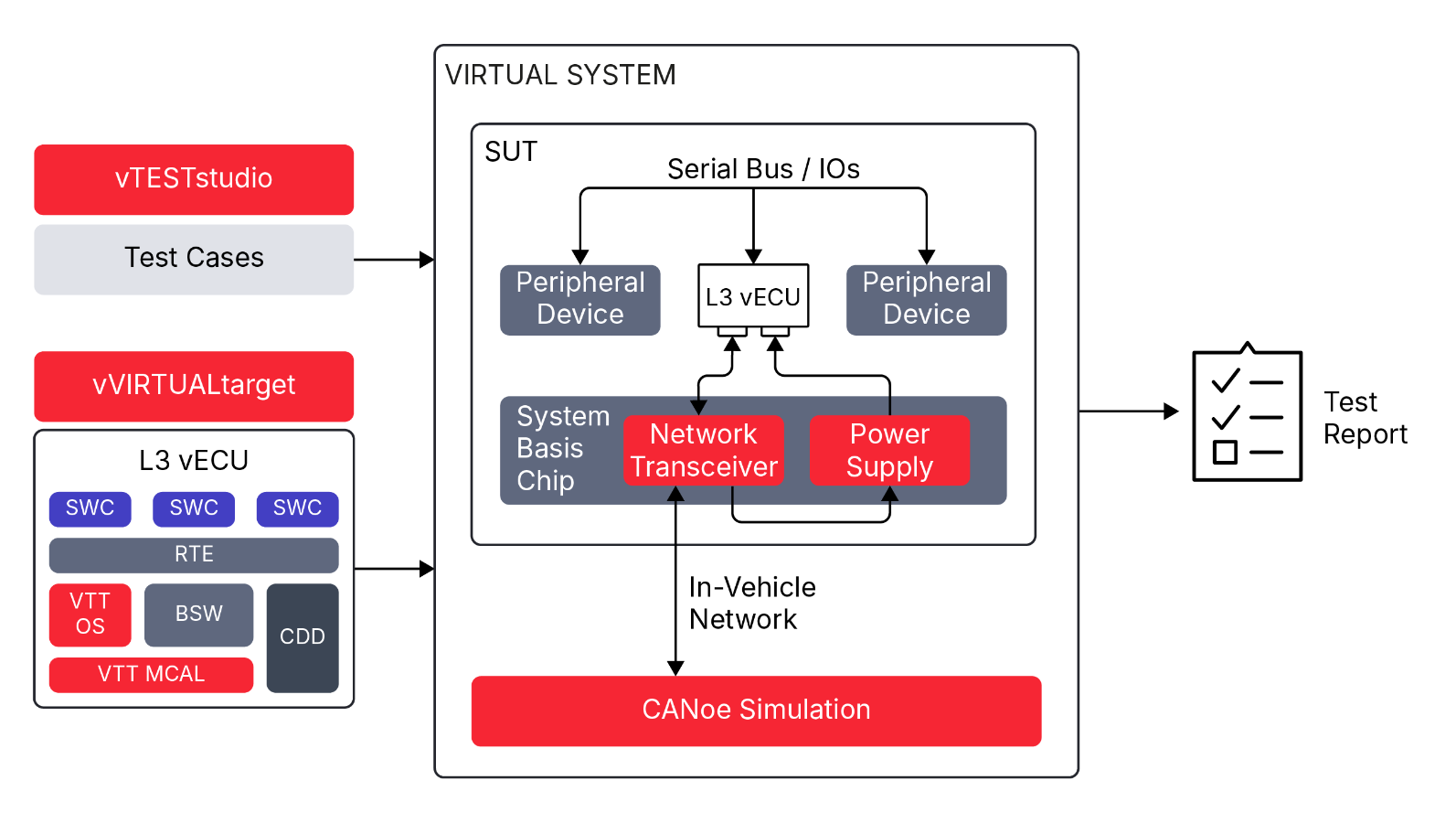
To enable SIL testing, a Level 3 vECU1 is created using vVIRTUALtarget. The tooling replaces OS and MCAL drivers with virtual equivalents. Complex Device Drivers (CDDs) were ported to the virtual platform. This approach ensures that the same application software runs on both the virtual and real ECU, maintaining functional equivalence across environments.
The virtualization approach includes the CAN transceiver driver. This allows accurate network simulation, including the transmission and reception of CAN messages and the handling of network management frames, even when the vECU is in sleep mode or powered off. A virtual network transceiver monitors CAN traffic. It can trigger wake-up or power-on transitions by activating the virtual power supply or by triggering a wake-up interrupt via GPIO, replicating the behavior of the physical setup.
CAPL scripts simulate peripheral devices within a CANoe configuration. CANoe System Variables provide the means to stimulate the virtual ECU with analog and digital signals, enabling interaction with buttons, switches, and other inputs. Serial communication interfaces such as I²C are also emulated through this mechanism, ensuring complete coverage of communication scenarios. This setup creates a realistic environment where the vECU can interact with simulated external devices and networks as if it were operating in a physical system.
Manual test procedures were converted into automated test cases, executed via CANoe and managed using vTESTstudio. This forms the basis for Continuous Integration and Continuous Testing (CI/CT) within server-based pipelines, e.g., with CANoe Server Editions.
By virtualizing drivers, hardware components, and peripheral interactions, this solution provides a fully virtualized test environment that replicates hardware behavior, supports early software validation, and integrates seamlessly into automated workflows. It enables early testing of integrated software without the real hardware, leading to effective retests and regression tests after bug fixes and change requests.
The Advantages
Earlier testing, software reuse and automation enable faster delivery, higher quality and early risk mitigation.
- Testing time was significantly reduced from 10 days to less than 8 hours
- Manual tests are replaced with automated cases, making development agile and ready for Software-Defined Vehicles
- Closed loop testing and debugging is possible without the need for a real hardware system
- The same application software and AUTOSAR BSW run on both the virtual and real ECU targets
- Virtual environments allow for parallel execution and easy scaling
- Shift-Left enables earlier validation in the development cycle, reducing late-stage defects and integration issues