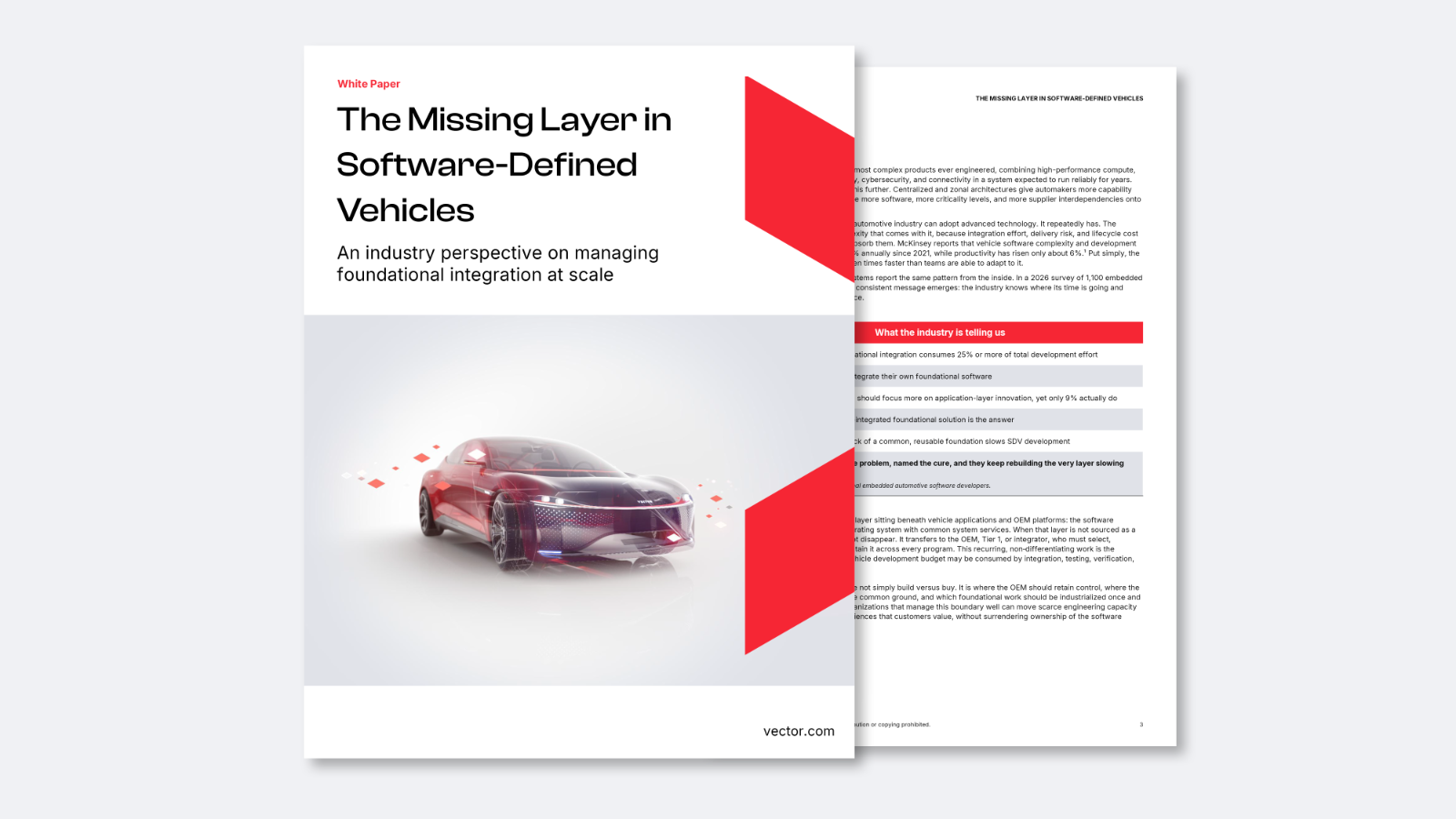
The Missing Layer in Software-Defined Vehicles
An industry perspective on managing foundational integration at scale
Software-defined vehicles are transforming automotive development, but growing software complexity also increases integration effort, cost, and delivery risk. In this white paper, we explore where this foundational integration work comes from and why it is repeatedly rebuilt across vehicle programs. Discover how a common, reusable software foundation can help reduce the integration tax, accelerate production readiness, and free engineering capacity for the innovations that differentiate your vehicles.
Summary
The modern vehicle is one of the most complex products ever engineered, combining high-performance compute, real-time control, functional safety, cybersecurity, and connectivity in a system expected to run reliably for years. Software-defined vehicles push this further. Centralized and zonal architectures give automakers more capability and flexibility, but also concentrate more software, more criticality levels, and more supplier interdependencies onto shared compute.
The challenge is not whether the automotive industry can adopt advanced technology. It repeatedly has. The challenge is managing the complexity that comes with it, because integration effort, delivery risk, and lifecycle cost are rising faster than teams can absorb them. McKinsey reports that vehicle software complexity and development effort have each grown about 40% annually since 2021, while productivity has risen only about 6%.¹ Put simply, the complexity is growing almost seven times faster than teams are able to adapt to it.
The developers building these systems report the same pattern from the inside. In a 2026 survey of 1,100 embedded automotive software engineers, a consistent message emerges: the industry knows where its time is going and keeps spending it in the same place.
What the industry is telling us
60% | say foundational integration consumes 25% or more of total development effort |
69% | build or integrate their own foundational software |
76% | say OEMs should focus more on application-layer innovation, yet only 9% actually do |
34% | say a pre-integrated foundational solution is the answer |
75% | say the lack of a common, reusable foundation slows SDV development |
The industry has diagnosed the problem, named the cure, and they keep rebuilding the very layer slowing them down.³ Based on a survey of 1,100 international embedded automotive software developers. | |
What these findings describe is a layer sitting beneath vehicle applications and OEM platforms: the software foundation that combines the operating system with common system services. When that layer is not sourced as a coherent whole, the work does not disappear. It transfers to the OEM, Tier 1, or integrator, who must select, integrate, tune, validate, and maintain it across every program. This recurring, non‑differentiating work is the integration tax. Up to 40% of a vehicle development budget may be consumed by integration, testing, verification, and validation before SOP.²
The strategic question is therefore not simply build versus buy. It is where the OEM should retain control, where the industry should standardize, share common ground, and which foundational work should be industrialized once and reused across programs. The organizations that manage this boundary well can move scarce engineering capacity upward, toward the vehicle experiences that customers value, without surrendering ownership of the software platform that defines the vehicle.
White Paper Overview
- Section 1 outlines the SDV paradox of increasing ambition and pressure on development velocity.
- Section 2 provides a clearer taxonomy for the vehicle software stack.
- Section 3 illustrates why the missing layer represents real work.
- Section 4 outlines how industry alignment is creating the conditions for scale.
- Section 5 examines the integration tax and where cost and uncertainty accumulate.
- Section 6 outlines different paths to production readiness and their impact on time to market.
- Section 7 details what a production-grade automotive OS foundation requires.
- Section 8 provides a decision framework for OEM leaders.
- Conclusion summarizes how to eliminate unnecessary software work.